
Authentication
- Email authentication
- Account security
- Protected application areas
Project · AI SaaS Platform
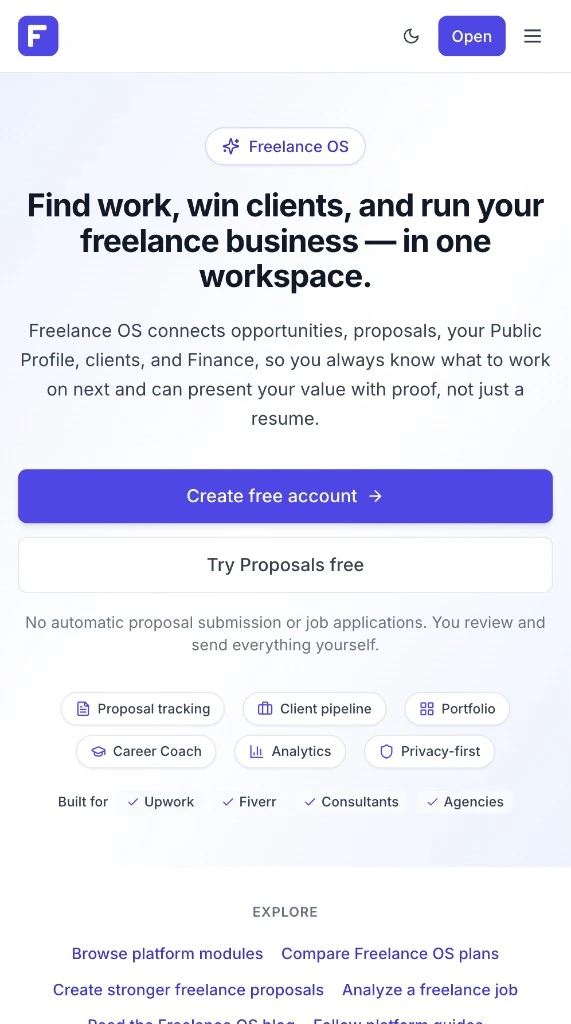
The AI operating system for freelancers.
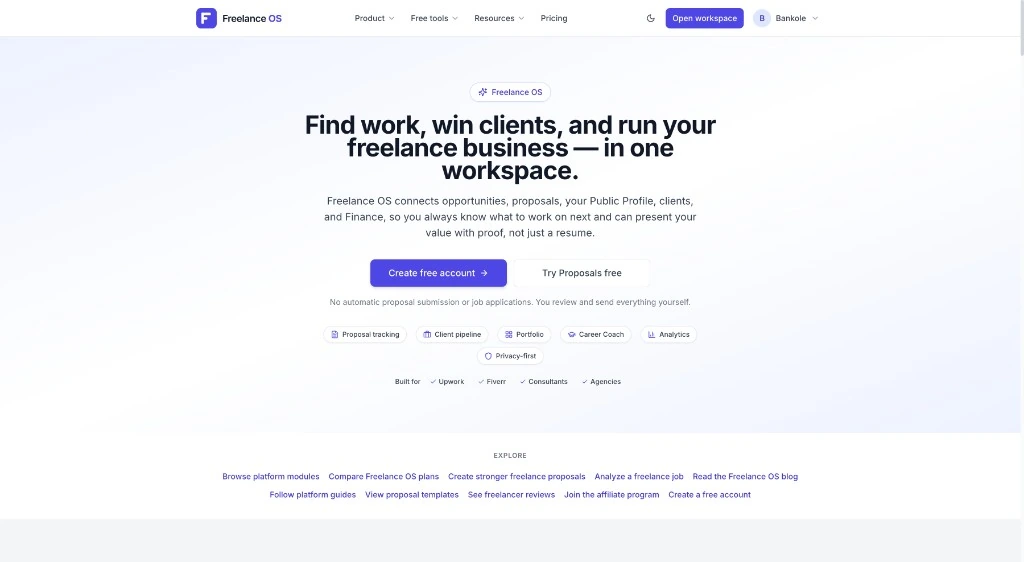
Freelance OS brings the fragmented workflow of running a freelance business into one connected platform — from finding opportunities and writing proposals to managing clients, building proof of work and understanding performance.
The live website may have changed since this case study was published and may differ from the work shown here.
The project
Freelancers often run their businesses across disconnected tools.
Opportunities may live on freelance marketplaces, proposals in documents or AI tools, clients in spreadsheets, portfolio projects somewhere else, and business performance across several dashboards.
Freelance OS was designed around a different idea: treat freelancing as a complete business workflow rather than a collection of isolated tasks.
The platform connects opportunity discovery and analysis, proposals, applications, clients, portfolio proof, services, profiles, analytics and AI guidance through one shared system.
The goal was not simply to build another proposal generator.
It was to create infrastructure for running and improving a freelance business.
The challenge
Freelancers frequently move between marketplaces, AI writing tools, spreadsheets, CRMs, portfolio builders, analytics tools and personal task systems. The challenge was connecting these workflows without creating another complicated dashboard.
Generic AI writing tools can generate proposals, but they often know very little about the freelancer actually applying. Freelance OS needed AI workflows capable of using structured freelancer context such as skills, experience, portfolio projects, services and relevant work history.
Finding more jobs does not automatically improve freelance outcomes. The product needed to help users evaluate opportunities before applying and connect those decisions to proposals, applications and eventual outcomes.
Applications, leads and clients require follow-ups. The platform needed a workflow that could continue from opportunity discovery through proposal, interview, client relationship and completed work.
Strong previous work can improve future positioning, but project information is often scattered or poorly presented. Freelance OS needed a way to turn experience into reusable portfolio proof and client-facing case studies.
Tracking proposals without learning from outcomes creates another database rather than a useful operating system. Freelance OS needed analytics capable of connecting activity with reported outcomes so freelancers could understand patterns in their business.
The platform contains many connected modules. The design challenge was making those capabilities feel like parts of one system instead of a collection of unrelated SaaS tools.
Product principles
Information entered once should become useful throughout the platform. A freelancer's skills, work history, portfolio, services and preferences can support multiple workflows rather than being repeatedly entered.
AI should operate on relevant structured information instead of treating every request as an isolated prompt.
Dashboards should help users determine what to do next rather than simply showing more statistics.
Portfolio work, outcomes and demonstrated experience should strengthen the freelancer's positioning.
Opportunities, proposals, clients and completed work should connect logically.
AI assists with analysis, drafting and guidance. Users review and submit proposals themselves — the platform does not apply for jobs or send messages on their behalf.
Our approach
We mapped the product around the journey from positioning and opportunity discovery through proposal creation, application tracking, client management, completed work and performance analysis.
Core profile, skills, experience, portfolio and service information were structured so different product modules could work from the same underlying freelancer context.
Opportunities, proposals, CRM, portfolio, services, analytics, billing and other areas were designed as distinct product domains while remaining connected through the wider platform.
AI workflows were designed around specific jobs rather than a single generic chat interface. Opportunity analysis, proposal generation, portfolio writing and guidance can use the context appropriate to each task.
Authentication, subscriptions, usage controls, notifications, administration, security and other supporting systems were developed as part of the SaaS infrastructure.
The architecture needed to support additional freelancer workflows without turning the product into an increasingly fragile collection of features.
The solution
Freelance OS became a modular SaaS platform connecting the activities freelancers perform before, during and after winning client work. Rather than treating each feature as a separate tool, the product uses shared context and connected workflows to help users move between opportunities, proposals, relationships, proof and performance.
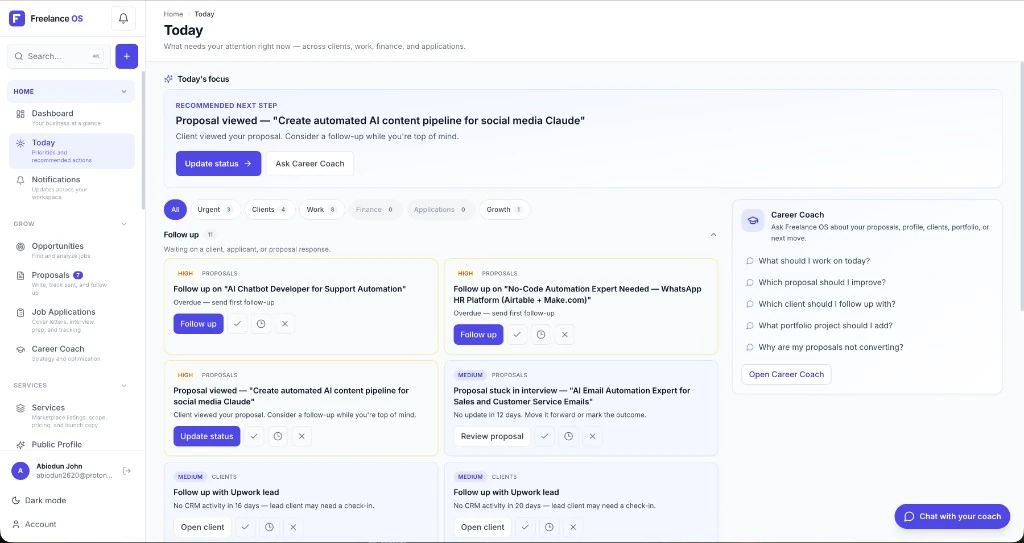
Today
The Today experience brings important actions and business context together so users can quickly understand what deserves attention — including follow-ups, high-fit opportunities, profile improvements and recent activity. It is designed as the user's starting point rather than another analytics dashboard.
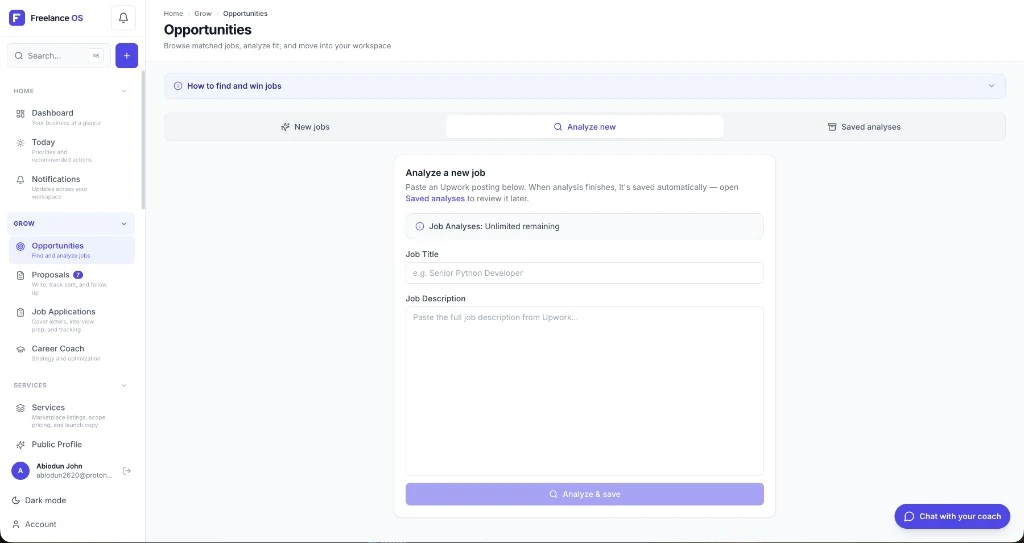
Opportunity Intelligence
Freelance OS helps users evaluate opportunities before investing time and platform resources into an application. Opportunity analysis can consider job requirements alongside relevant freelancer information to surface useful context around fit, requirements and positioning. The goal is not simply to collect more opportunities — it is to support better application decisions.
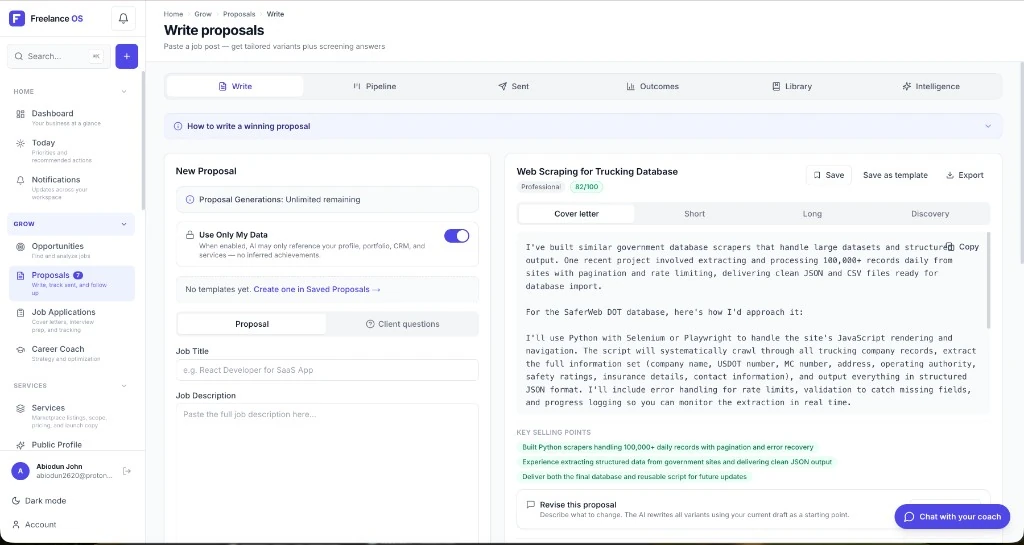
AI Proposal Generator
The proposal system was designed to move beyond generic AI-generated pitches. Freelance OS can use structured freelancer context such as skills, experience, portfolio projects and relevant work history when helping create proposal drafts. Users remain responsible for reviewing and submitting their proposals.
Proposal & Application Tracking
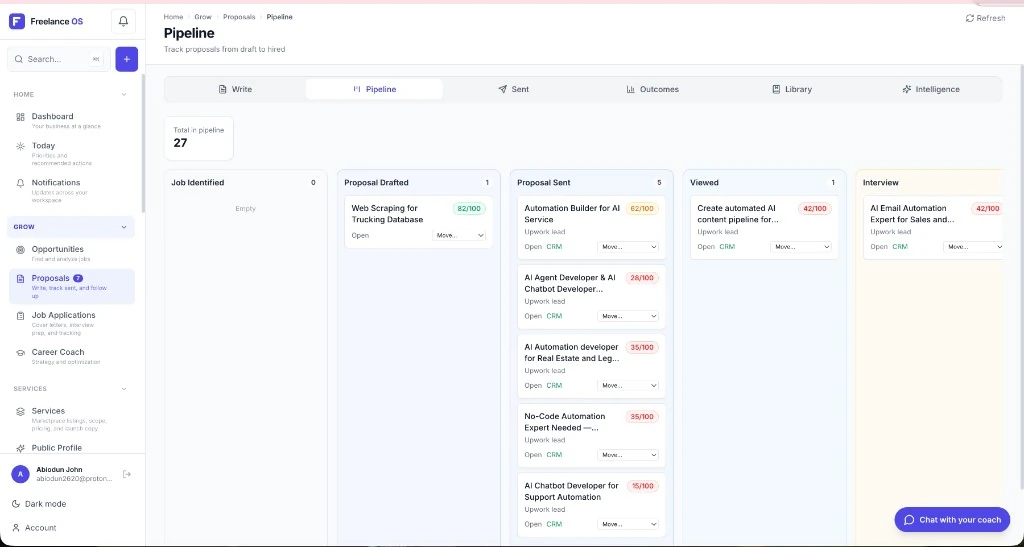
Applications can be organized through a structured workflow so freelancers can keep track of what they applied for, what needs follow-up and what eventually happened. Stages such as opportunity, proposal, viewed, interview, hired, won and lost help users understand where each application stands based on information they record in the platform.
Client Pipeline
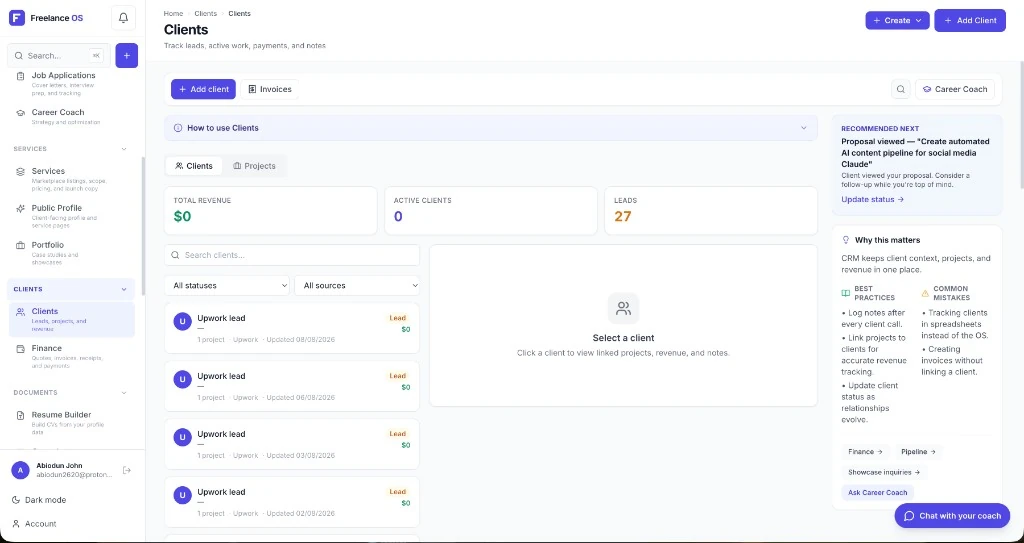
Freelance OS extends beyond applications by providing a structured place to manage prospects, clients, projects, contact information, notes and follow-ups. The CRM connects business development with the wider freelance workflow rather than requiring users to maintain a separate generic sales system.
Portfolio Studio
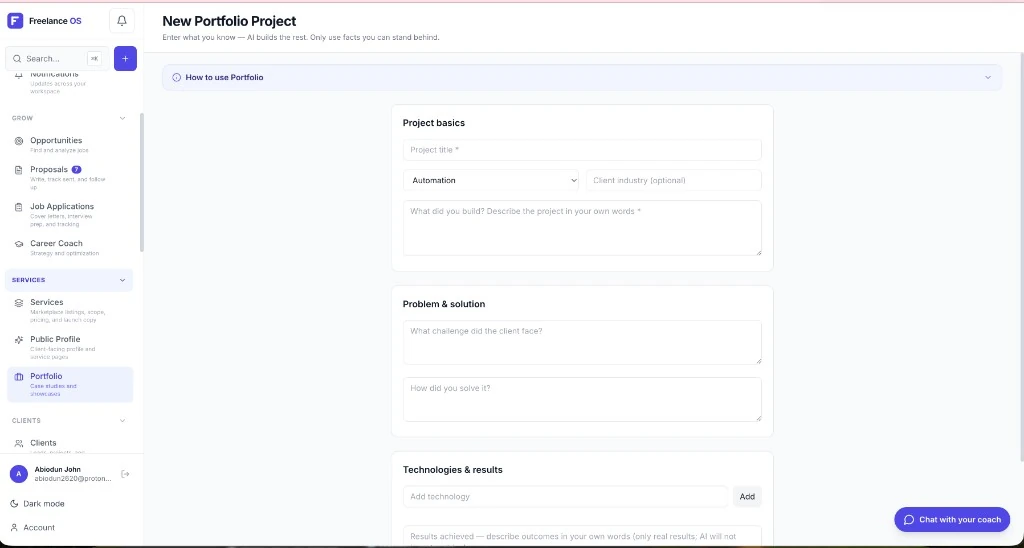
Freelance OS helps users organize projects and transform their experience into stronger portfolio assets. Portfolio Studio supports the broader system by making previous work available as context when presenting services, improving positioning and preparing future proposals.
Services
Freelance OS allows users to develop clearer client-facing service offerings from their skills and experience, with support for marketplace listings, project catalog content, positioning copy and related presentation assets where those workflows are enabled in the product.
Profile
Instead of treating profile information as onboarding data that is never used again, Freelance OS makes freelancer context available across relevant workflows. Profile readiness, skills, work history, testimonials and improvement recommendations help users develop stronger positioning over time.
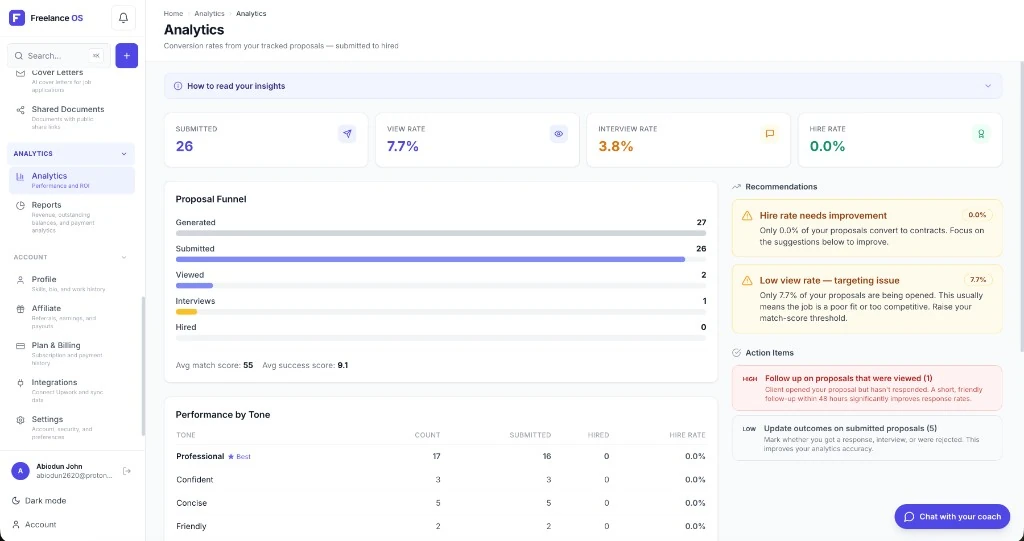
Insights
Freelance OS brings activity and outcome data together so users can understand their freelance workflow beyond raw application counts. Depending on the data available, analytics can include proposal activity, reported views, interviews, hires, wins and losses, funnel performance and performance trends.
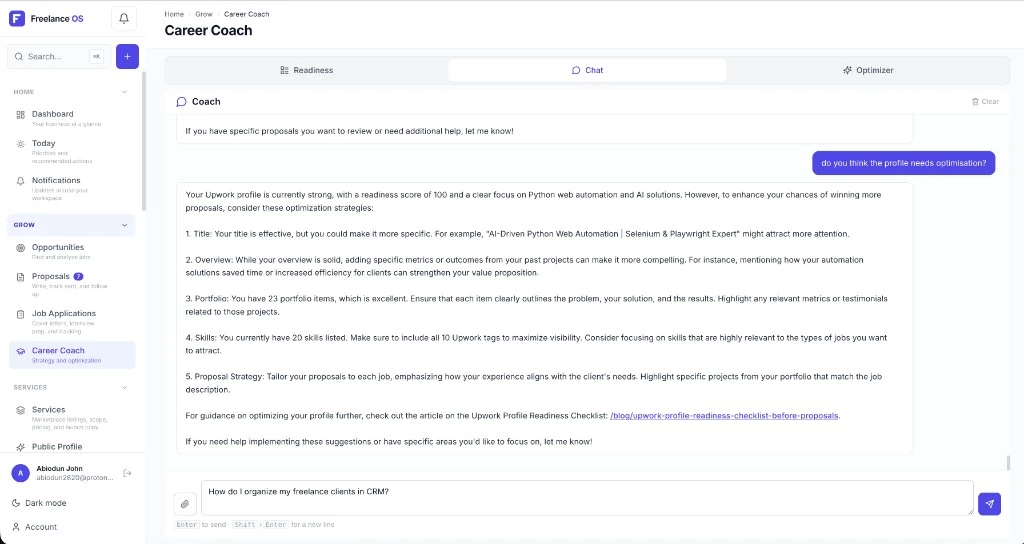
Career Coach
The coaching experience is designed to understand more than the user's latest message. Where permitted by the application's architecture, guidance can draw from relevant Freelance OS context such as profile information, portfolio, services, proposals and business activity.
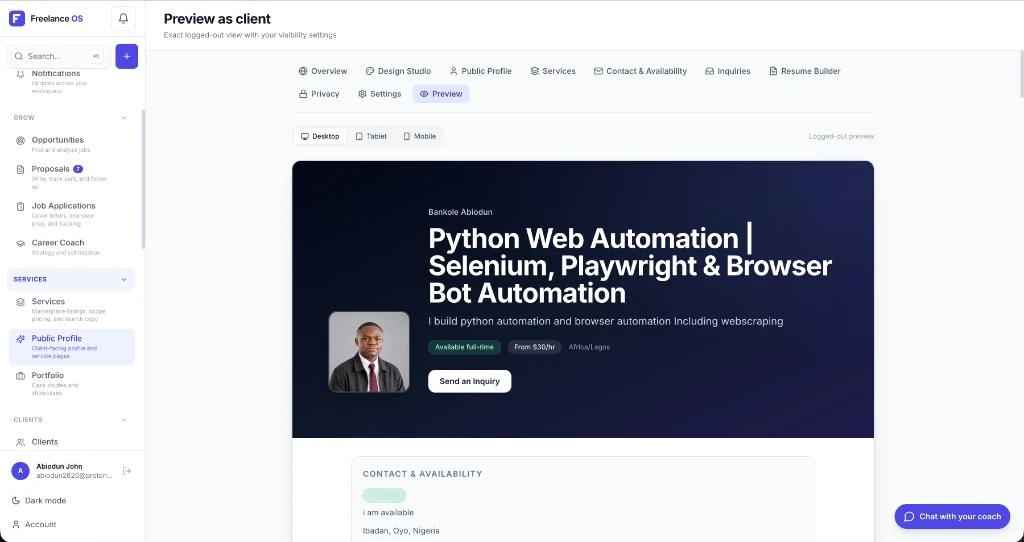
Public Profile
Freelance OS includes public-facing profile infrastructure that allows freelancers to present selected profile, portfolio and service information through a client-facing experience with hire actions, contact options and privacy controls managed by the user.
Project highlights
Outcome
Freelance OS developed into a broader SaaS platform for managing the workflows behind independent work. Opportunity analysis, proposal creation, application tracking, client management, portfolio development, services, profile improvement and analytics are connected through shared product infrastructure rather than operating as isolated tools.
Connected freelancer workspace
AI-assisted opportunity analysis
Context-aware proposal workflows
Application pipeline
Freelancer CRM
Portfolio and proof-of-work system
Service positioning tools
Profile and growth workflows
Performance analytics
Public profile infrastructure
Subscription and entitlement system
Notification infrastructure
Administration and operational tooling
Responsive application experience
SaaS infrastructure
Product architecture
Freelance OS is organized around shared freelancer context and connected product domains rather than isolated feature pages.
Freelance OS
Freelancer context
Profile · Skills · Work · Proof
Win work
Opportunities → Analysis → Proposals → Pipeline
Run relationships
Leads → Clients → Projects
Present proof
Portfolio → Services → Public Profile
Learn and improve
Analytics → Insights → Career Coach
Supporting infrastructure
Authentication · Billing · Notifications · Administration
Engineering
Freelance OS was developed as a custom application with separate frontend, backend, data and infrastructure layers rather than as a conventional content website.
Services used
Product & UI Design
Designing a complex SaaS workspace around connected freelancer workflows while keeping individual tools understandable and actionable.
SaaS / Web Application Development
Building the frontend and backend systems supporting authenticated dashboards, business workflows, subscriptions and platform operations.
AI Integration
Designing task-specific AI workflows that use relevant freelancer context for analysis, drafting and guidance.
Automation & Integrations
Connecting authentication, notifications, billing and other product workflows across the application.
Platform Architecture
Structuring a modular application capable of supporting multiple connected product domains without turning the experience into disconnected tools.
Platform
Freelance OS combines a modern Next.js application frontend with a Python FastAPI backend and structured data services to support a growing collection of connected freelance workflows. The platform separates presentation, business logic and data infrastructure while allowing features such as opportunities, proposals, clients, portfolio, analytics, billing and administration to work through shared product services.
More work
Other Smartlance projects with related industries, platforms or services.
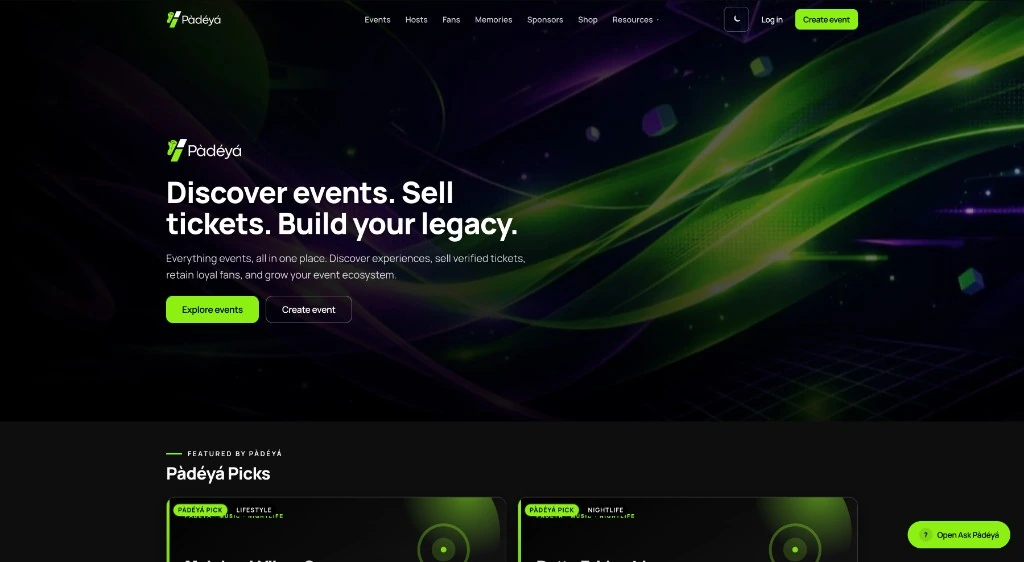
Event Technology · Next.js + FastAPI
Product Design · Web Application Development
View Case Study
If you are building a SaaS platform, AI product, dashboard or custom web application, tell us what the product needs to do and where you are in the build.
Tell us what you're building, redesigning or trying to improve. We'll help you figure out the right next step.